

London landmark
Marble Arch history: why it moved and what is nearby
Short answer
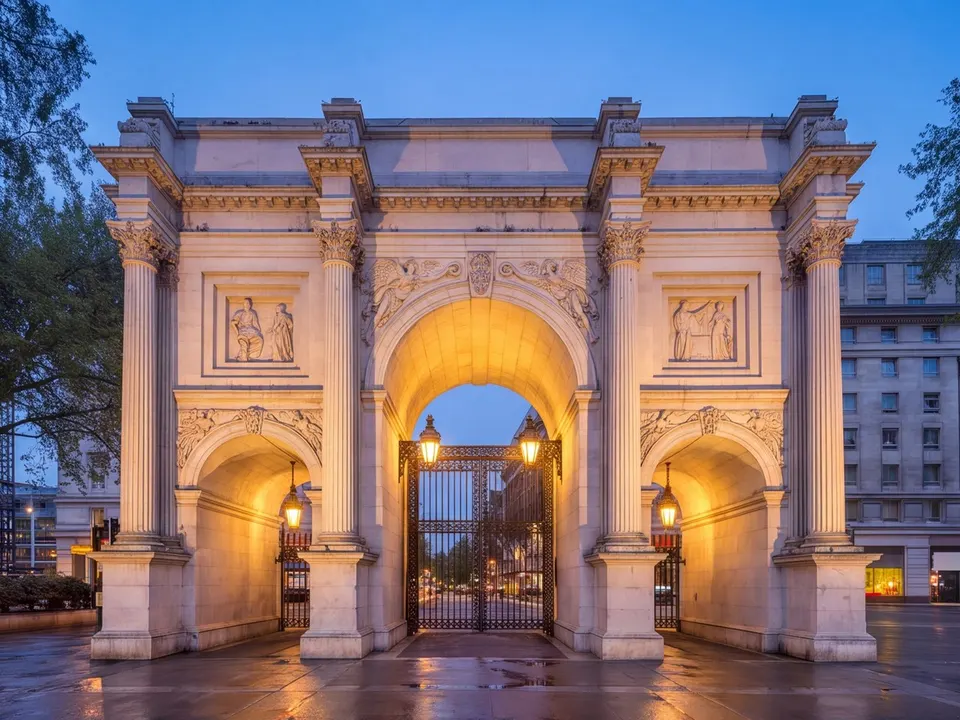
Marble Arch is the white marble triumphal arch that John Nash designed as the ceremonial gateway to Buckingham Palace[2][3]. It was moved in 1851 to the north-east corner of Hyde Park, where it now stands isolated on a roundabout at the western end of Oxford Street[1][2][6]. It is Grade I listed, and the Central line station of the same name serves it[2][6].
History
Historic England dates Nash's design to 1828, while Wikipedia says work on it began in 1827, so the sources differ by a year[1][2]. He drew on two Roman and Parisian models, the Arch of Constantine and the Arc de Triomphe du Carrousel[1][2]. The arch is about 45 ft high and stands on a footprint of 60 by 30 ft[1]. Wikipedia says it is faced with Carrara marble, with embellishments from quarries near Seravezza, while Historic England names Seravezza marble[1][2].
John Flaxman, chosen for the commemorative sculpture, died in 1826, and the commission was split between Westmacott, Baily and Rossi[1]. The friezes meant for the attic were used on the facades of Buckingham Palace instead[2]. An equestrian statue of George IV was meant to crown the arch, and it was installed in Trafalgar Square in 1843[1][2]. George IV died in 1830, work stopped because his successor William IV found the costs unacceptable, and Edward Blore finished the arch in 1833[1].
It was taken down in 1847 and rebuilt by Thomas Cubitt at Cumberland Gate, at the north-east corner of Hyde Park, with the work done by March 1851[1]. London Remembers says it was moved because the Palace's east wing was built where the arch had stood, and it debunks the popular story that the royal coach could not fit through, since the 1953 coronation coach passed under it[3]. Inside the arch there are three small rooms, which served as a police station until at least 1968[3].
A gyratory system arrived in 1926, and the road works of 1960 to 1962 left the arch on a traffic island[1]. The Tyburn gallows, used for public executions from 1388 to 1793, stood in this part of London[1]. Marble Arch tube station opened on 30 July 1900[1][6]. Historic England listed the arch at Grade I on 5 February 1970[2].
At night and at Christmas
The pedestrian gates of Hyde Park are listed as 05:00 to midnight[5]. For Christmas 2026, Time Out gives Monday 9 November as the Oxford Street switch-on date, with a Harry Potter twist this year alongside classic star illuminations[7]. Marble Arch sits at the western end of Oxford Street[6].
Visiting: what to know
The arch stands isolated on a roundabout[2]. Do not mix it up with the Wellington Arch, because Marble Arch is at the north end of Park Lane and the Wellington Arch is at the south[3].
Speakers' Corner lies along the north-east side of Hyde Park, not at the arch itself, though it is the part of the park closest to Marble Arch and Oxford Street[3][4], and crowds often gather there on Sunday mornings[4]. Parliament designated the area for public speaking in 1872[4]. At the time of writing, 11 Nov 2026, the Royal Parks page gives the park's pedestrian gate times as 05:00 to midnight, so check before you go[5].
Getting there
Marble Arch station is on the Central line, between Lancaster Gate and Bond Street[6]. Its main entrance sits in the middle of the Cumberland Hotel, on the junction's north-east side, at the western end of Oxford Street[6]. Bond Street, the next Central line station along, also has Jubilee line and Elizabeth line services[6][8].
Last trains home from 17 London areas
| Station | Lines | Walk, estimated |
|---|---|---|
| Marble Arch | Central | about 50 m, about 1 min |
| Bond Street | Elizabeth line, Central, Jubilee | about 850 m, about 11 min |
| Edgware Road (Circle Line) | Circle, District, Hammersmith & City | about 1.3 km, about 17 min |
On the Christmas lights trails
Stop 1 of 5 on Mayfair & Bond Street. See it on the Christmas Trails map.
- The trail starts here.
- Next: The Audley Public House (about 850 m, about 11 min on foot)
Walking times are estimates from the stops’ coordinates. Every walk: Christmas lights in London.
Nearby for a drink
Pubs and bars within 600 m of Marble Arch as the crow flies, nearest first, with an estimated walk. Where we have written about a venue, its name opens that entry on our page for the area; the others open on the London nightlife map.
- The Churchill Bar & Terrace · Hotel barabout 350 m, about 5 min
- Harry Gordons Bar & Kitchen · Barabout 550 m, about 8 min
- The Fount Bar · Wine barabout 700 m, about 9 min
- The Duchess · Pub on the mapThe Duchess is a high-ceilinged pub on Duke Street, opposite the Duke Street entrance of Selfridges.about 700 m, about 9 min
- Burlock · Cocktail barabout 700 m, about 9 min
- The Barley Mow Mayfair · Pub on the mapThe Barley Mow is a Cubitt House pub on Duke Street, close to Hyde Park and Bond Street.about 700 m, about 10 min
More nearby: Pubs in Marylebone · Pubs in Mayfair
Clock in here
MYSOVA is a London social passport: clock in at bars, pubs and clubs, earn XP and meet people where you go.



Free · UK App Store and Google Play · 18+
FAQ
Who designed Marble Arch?
John Nash designed it in the 1820s as a gateway to Buckingham Palace[2].
Why was Marble Arch moved?
What was Marble Arch originally built for?
It was built between 1827 and 1833 as a grand way in to the palace from the Mall[3].
Is Marble Arch the same as Speakers' Corner?
Which tube station is Marble Arch?
Marble Arch station, on the Central line, which opened on 30 July 1900[6].
Nearby venues
Landmarks in the area
Area guides
Sources
- 1.Wikipedia, Marble Arch. Read .
- 2.British Listed Buildings, reproducing the Historic England list entry, The Marble Arch, Grade I list entry text (Historic England 1239534). Read .
- 3.London Remembers, Marble Arch. Read .
- 4.The Royal Parks, Speakers' Corner. Read .
- 5.The Royal Parks, Hyde Park. Read .
- 6.Wikipedia, Marble Arch tube station. Read .
- 7.Time Out, Every major Christmas light display switch-on date for 2026. Read .
- 8.Wikipedia, Bond Street tube station. Read .