

London landmark
Regent's Park: history, Nash, Primrose Hill and the Zoo
Short answer
Regent's Park is a 410-acre Royal Park in north London, laid out to a plan by John Nash for the Prince Regent.[1][4] After dark the place to head for is Primrose Hill, which rises 63 metres and has a legally protected view of St Paul's Cathedral and Westminster.[3] The park's gates close earlier in winter than in summer, so check the day's hours before an evening visit.[5]
History
The park's layout comes from a scheme John Nash drew up for the Prince Regent, later George IV; the London Museum places the commission in the early 1800s.[3] The ground itself was Marylebone Park, once part of a larger forest, and Henry VIII took 554 acres of it for hunting; the London Museum dates that seizure to 1539.[1][3] Between 1649 and 1660 as many as 16,000 trees were felled and land was sold off to pay for the Civil War, and the park was then let to tenant farmers for about 150 years.[1]
Nash's plan included a large round park, Regency villas, a palace and a processional road that survives as Regent Street, but the cost put the Prince Regent off and only eight villas went up.[1] The builder James Burton bought many of the leases in 1816, and his own house, The Holme, was completed in 1818.[4]
London Zoo opened in one corner in 1828 for members of the Zoological Society and admitted the general public in 1847.[3] The east side of the park opened to the public in 1835[1], and Wikipedia says that first opening was on two days a week.[4] In 1838 the Royal Botanic Society laid out the Inner Circle with lawns and a lake, on ground that is now the rose collection in Queen Mary's Gardens.[1]
During the Blitz, bombs destroyed several of Nash's terraces.[3] A bomb destroyed Holford House in 1944, and it was demolished in 1948.[4] Today the Crown Estate owns the freehold, The Royal Parks manages the public grounds, and the park is Grade I on the Register of Historic Parks and Gardens.[4] Wikidata classes it as part of the Royal Parks of London.[8]
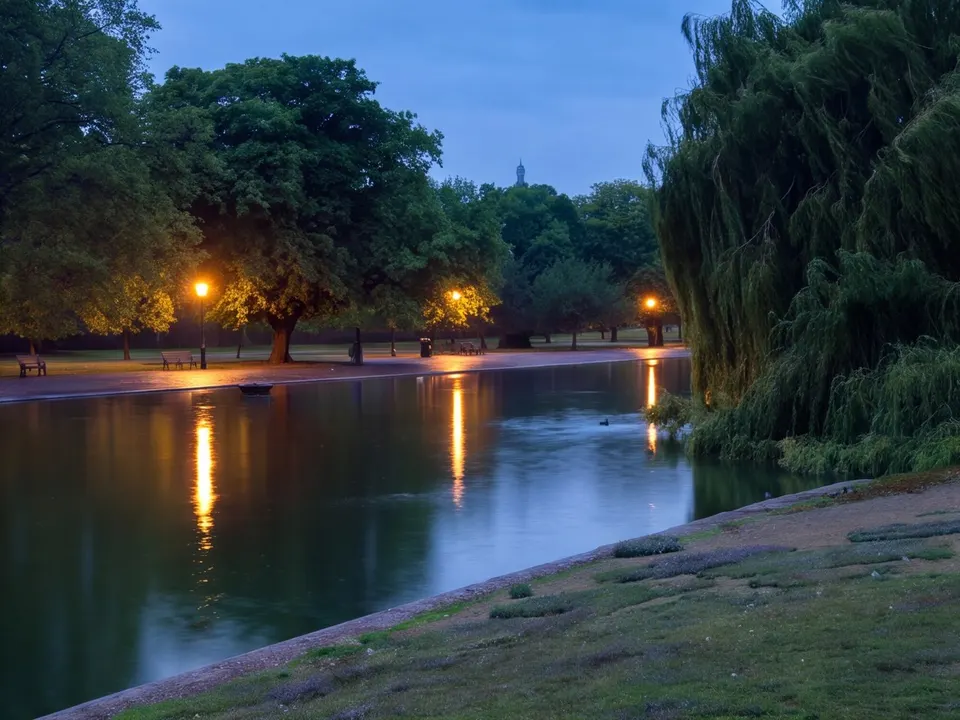
At night
The Friends of Regent's Park say closing time moves with the seasons, as early as 16:00 in the darkest months and as late as 21:30 in high summer.[5] The Royal Parks key-information panel gives the pedestrian gates as 05:00 to 16:30, while its FAQ says they shut at dusk.[2][7] In winter, plan on leaving in the late afternoon and confirm the current schedule on the Royal Parks site.[5] Vehicle gates are listed as 07:00 to midnight.[2]
The Royal Parks says Primrose Hill is locked from 22:00 to 06:00 during the British Summer Time months, March to October.[7] At the summit, 63 metres above sea level, the trees are kept low so that the sightlines to St Paul's Cathedral and Westminster stay open, and those two views are protected by law.[3] It is one of London's six protected viewpoints.[3] Neither Royal Parks page says anything about lighting on the paths.[2][7]
Visiting: what to know
At the time of writing, 11 Nov 2026, the Royal Parks FAQ lists charges for car parking, public toilets (20p) and the London Zoo car park, and mentions no charge to enter the park.[7] Closing times vary with the season, so check before you go.[5]
Some of the toilets listed by the Friends take card payment only, and they may close early for cleaning.[5] Dogs generally do not need a lead but must be under control, with exceptions including the Avenue Gardens, Queen Mary's Gardens and the area around the boating lake.[2] Disabled parking bays sit around the Inner and Outer Circles, and Blue Badge holders park free for up to four hours.[2]
Getting there
The nearest Underground station is Regent's Park, on the Bakerloo line.[6] The Royal Parks also names Great Portland Street (Circle line) and Warren Street (Northern and Victoria lines), and lists London Euston and Marylebone as the closest mainline stations.[2]
Last trains home from 17 London areas
| Station | Lines | Walk, estimated |
|---|---|---|
| Regent's Park | Bakerloo | about 750 m, about 10 min |
| Baker Street | Bakerloo, Circle, Hammersmith & City, Jubilee, Metropolitan | about 850 m, about 11 min |
| Great Portland Street | Circle, Hammersmith & City, Metropolitan | about 850 m, about 11 min |
Clock in here
MYSOVA is a London social passport: clock in at bars, pubs and clubs, earn XP and meet people where you go.



Free · UK App Store and Google Play · 18+
FAQ
Is Regent's Park free to enter?
What time does Regent's Park close?
Is Primrose Hill open at night?
Who designed Regent's Park?
Landmarks in the area
Sources
- 1.The Royal Parks, History of Regent's Park and Primrose Hill. Read .
- 2.The Royal Parks, Regent's Park visitor information. Read .
- 3.London Museum, A history of Regent's Park and Primrose Hill. Read .
- 4.Wikipedia, Regent's Park. Read .
- 5.Friends of Regent's Park and Primrose Hill, Opening times and toilets. Read .
- 6.Transport for London, Regent's Park Underground Station. Read .
- 7.The Royal Parks, Regent's Park FAQs. Read .
- 8.Wikidata, Regent's Park (Q739341). Read .