

London landmark
Waterloo Bridge: history, the Ladies' Bridge and night views
Short answer
History
The first Waterloo Bridge was designed by the Scottish engineer John Rennie. It was first known as the Strand Bridge and was renamed for the Battle of Waterloo, which Wikipedia dates to 1816, and it opened in 1817 as a toll bridge[1][3]. Problems with its piers, caused by the river scouring around them, began to show from 1884, and in May 1924 the bridge was closed to traffic because of structural trouble[3]. A temporary bridge was finished in August 1925, and demolition of the old bridge began in early October 1934[3][1].
The replacement is the bridge you cross today. Scott used reinforced concrete box girders faced in Portland stone, shaped to read like traditional arches[2][3]. Construction started in 1937 according to two sources, although the London Museum's photographs suggest 1935 or 1936[2][3][1]. The bridge was partly opened on 11 March 1942 and finished in 1945[2][3]. It is 1,230 feet (370 metres) long and 80 feet (24 metres) wide[3]. It has been listed Grade II* since 1981[3][2].
The bridge is also known as the Ladies' Bridge, because women are said to have made up most of the wartime workforce[2][3]. The London Museum notes that women worked on it between 1939 and 1945, and it points to a 1944 photograph of women acetylene welders that historian Christine Wall found in 2015[1]. The size of their share is debated: the ICE (Institution of Civil Engineers) has published an article on the story titled "legend or fact?"[3].
At night
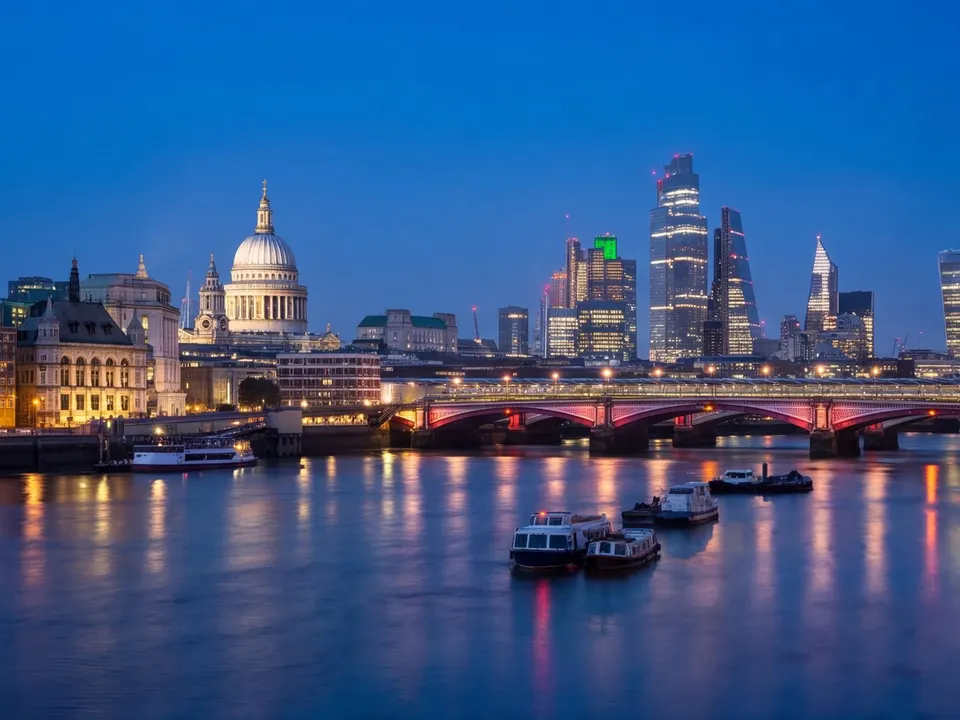
Waterloo Bridge is one of nine Thames bridges lit by the Illuminated River artwork by Leo Villareal, which uses LEDs to project moving patterns of light[4]. Waterloo Bridge was in the second phase, begun in July 2020 and finished in April 2021[4].
The view is the reason to stop. South Western Railway says the bridge has views taking in Westminster and the London Eye to the west and St Paul's Cathedral and Canary Wharf to the east[5]. Underneath the bridge is the South Bank Book Market, a second-hand book market that its page says has run daily for 40 years[5].
Visiting: what to know
Waterloo Bridge is a public road bridge, 370 metres from end to end, so a walk across it takes in the whole stretch of the river[3]. Scott's design looks like a row of arches, but as built none of them is structurally an arch: the middle span is a cantilever with a suspended deck, and the spans either side are box girders[3]. He built jacks into the piers to guard against future subsidence, and he admitted he was not an engineer[2]. Granite from the old bridge was sent to parts of the Commonwealth, including a monument in Wellington, New Zealand[2].
Getting there
Wikipedia gives Temple as the nearest Underground station and Waterloo as the nearest National Rail station[3]. Temple is served by the Circle and District lines[7], and Waterloo Underground by the Bakerloo, Jubilee, Northern and Waterloo & City lines[6]. Embankment, on the Bakerloo, Circle, District and Northern lines, is another Underground option[8].
Last trains home from 17 London areas
| Station | Lines | Walk, estimated |
|---|---|---|
| Temple | Circle, District | about 400 m, about 6 min |
| Embankment | Bakerloo, Circle, District, Northern | about 550 m, about 7 min |
| Waterloo | Bakerloo, Jubilee, Northern, Waterloo & City | about 800 m, about 11 min |
Nearby for a drink
Pubs and bars within 600 m of Waterloo Bridge as the crow flies, nearest first, with an estimated walk. Where we have written about a venue, its name opens that entry on our page for the area; the others open on the London nightlife map.
- Gallery at the Savoy · Hotel barabout 350 m, about 5 min
- The Understudy · Bar on the mapThe Understudy is a bar in the National Theatre on Upper Ground, beside the Thames.about 350 m, about 5 min
- American Bar · Cocktail barabout 400 m, about 5 min
- Central Bar, Royal Festival Hall · Live musicabout 400 m, about 5 min
- Beaufort Bar · Barabout 450 m, about 6 min
- Me Hotel London - Radio roof top · Cocktail barabout 500 m, about 6 min
More nearby: Pubs in Covent Garden · Bars in Covent Garden · Pubs in South Bank · Bars in South Bank
Clock in here
MYSOVA is a London social passport: clock in at bars, pubs and clubs, earn XP and meet people where you go.



Free · UK App Store and Google Play · 18+
FAQ
Why is Waterloo Bridge called the Ladies' Bridge?
Who designed Waterloo Bridge?
How long is Waterloo Bridge?
Scott's bridge is 1,230 feet, or 370 metres, long[3].
What is the nearest station to Waterloo Bridge?
Wikipedia names Temple as the nearest Underground station and Waterloo as the nearest National Rail station[3].
Nearby venues
Nearby landmarks
Landmarks in the area
Sources
- 1.London Museum, Waterloo Bridge. Read .
- 2.Giles Gilbert Scott (gilbertscott.org), Waterloo Bridge. Read .
- 3.Wikipedia, Waterloo Bridge. Read .
- 4.Wikipedia, Illuminated River. Read .
- 5.South Western Railway, Guide to London's most famous bridges. Read .
- 6.Transport for London, Waterloo Underground Station. Read .
- 7.Transport for London, Temple Underground Station. Read .
- 8.Transport for London, Embankment Underground Station. Read .