

London landmark
Big Ben history: Elizabeth Tower facts and night views
Short answer
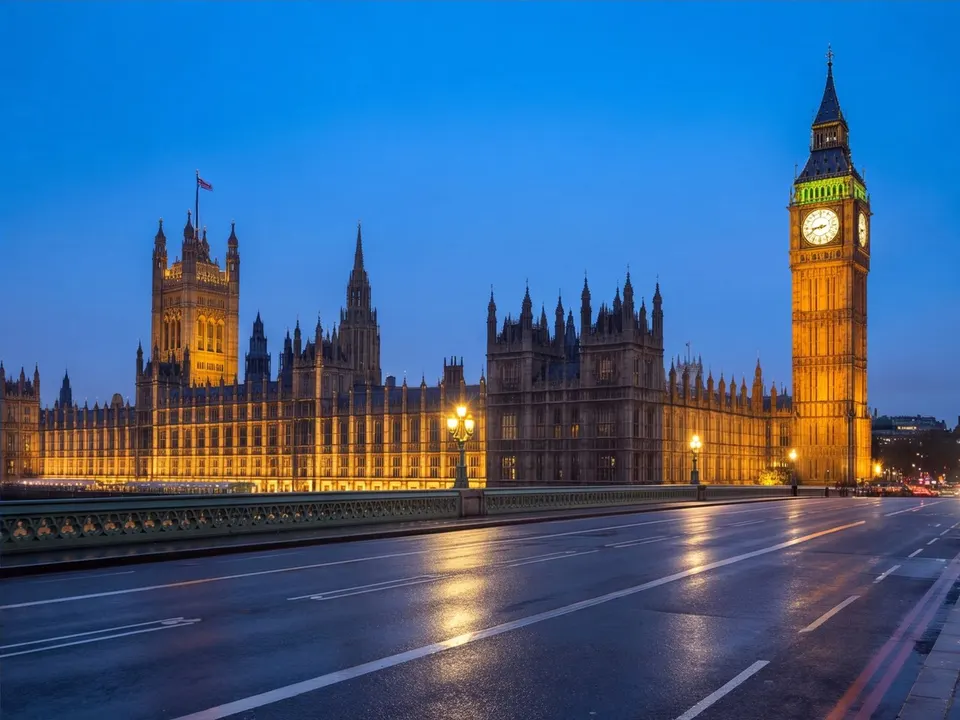
Big Ben is the name of the Great Bell, not the whole building, but most people use it for the tower, which has been officially called the Elizabeth Tower since 2012[1][2][3]. It stands 96 metres tall beside the Palace of Westminster, and after dark its four clock dials are lit and a lantern above them shines whenever Parliament is sitting late[2][3].
History
Work on what was then called the Clock Tower began on 28 September 1843[1][2]. The tower was completed in 1859, and the Great Bell was heard striking for the first time on 11 July that year[1]. The clock was designed by Edmund Beckett Denison with the Astronomer Royal George Airy and built by Edward John Dent[1][3].
The bell has a troubled story. The first one, cast in 1856, cracked during testing, and the replacement was cast at the Whitechapel Bell Foundry in 1858[1]. It weighs 13.7 tonnes and also cracked within a few months of going into service, so it was turned and the weight of the hammer was reduced[1][3].
The tower is 316 feet, or 96 metres, high, with 334 steps from the ground to the belfry[1][2]. Each dial is seven metres across and holds 324 pieces of opal glass[3]. The tower leans slightly, by roughly 230 millimetres to the north-west over its 55 metre height[2]. The clock is tuned with old pre-decimal pennies stacked on the pendulum, and each coin gains it two fifths of a second a day[3].
In 2012 the Clock Tower was renamed the Elizabeth Tower to mark Queen Elizabeth II's Diamond Jubilee[1][2]. The chimes were silenced on 21 August 2017 for a long conservation project, and the tower came out of its scaffolding in December 2021[1][2]. The estimated cost of the work rose from about £29 million to about £69 million, and the budget then reached nearly £80 million[1][2]. The Palace of Westminster was made a World Heritage Site in 1987[1].
At night
The dial lights were part of the original design and have shone almost every night since, apart from the Second World War, when they were switched off[3]. They ran on gas at first, then on electricity from 1906, and have been LEDs since the refurbishment finished in 2022[3]. Above the dials, the Ayrton Light was added in 1873 and shines when the House of Commons or House of Lords is still sitting after dark[1][3].
Westminster Bridge is the well-known place to look from, with the Palace of Westminster and Big Ben as the backdrop[6]. The bridge is one of nine lit by the Illuminated River artwork, whose second phase was completed in April 2021[5]. You can also hear the tower from the street: the Westminster Chimes sound every 15 minutes, and the bell strikes the hour[3]. BBC Radio first broadcast the bell on New Year's Eve 1923, and it is still heard on Radio 4 at 6pm and at midnight[3].
Visiting: what to know
Big Ben is a landmark you mostly see from the street, and Westminster Bridge is a well-known spot to look at it from[6]. Inside, it is 334 steps from the ground to the belfry[1]. The tower is part of the Palace of Westminster[1], so check Parliament's own pages if you want to go inside.
If you are there after dark, the bell strikes at 120 decibels from about 62 metres up, which is hard to miss[3]. The dials were painted black in the 1930s to hide the effect of pollution, and paint analysis showed the original colour was blue, so they were restored in Prussian blue[3].
Getting there
Westminster station is served by the Circle, District and Jubilee lines[4]. Waterloo, on the south side of the river, is served by the Bakerloo, Jubilee, Northern and Waterloo & City lines[7]. Check TfL for current lift and line notices before you travel.
Last trains home from 17 London areas
| Station | Lines | Walk, estimated |
|---|---|---|
| Westminster | Circle, District, Jubilee | about 100 m, about 1 min |
| St. James's Park | Circle, District | about 850 m, about 11 min |
| Embankment | Bakerloo, Circle, District, Northern | about 950 m, about 13 min |
Nearby for a drink
Pubs and bars within 600 m of Big Ben (Elizabeth Tower) as the crow flies, nearest first, with an estimated walk. Each opens on the London nightlife map.
- St Stephen's Tavern · Pubabout 100 m, about 1 min
- The Red Lion · Pubabout 200 m, about 3 min
- Westminster Arms · Pubabout 450 m, about 6 min
- Tattershall Castle · Pubabout 550 m, about 8 min
- Two Chairmen · Pubabout 650 m, about 9 min
- Blue Boar Pub · Pubabout 700 m, about 9 min
More nearby: Bars in South Bank
Clock in here
MYSOVA is a London social passport: clock in at bars, pubs and clubs, earn XP and meet people where you go.



Free · UK App Store and Google Play · 18+
FAQ
Is Big Ben the tower or the bell?
How tall is Big Ben?
Where is the best view of Big Ben at night?
Why does a light shine above the clock?
Where is the nearest tube station to Big Ben?
Westminster, on the Circle, District and Jubilee lines[4].
Nearby landmarks
Landmarks in the area
Sources
- 1.Wikipedia, Big Ben. Read .
- 2.Wikipedia, Elizabeth Tower. Read .
- 3.UK Parliament, Elizabeth Tower virtual tour. Read .
- 4.Transport for London, Westminster station. Read .
- 5.Wikipedia, Illuminated River. Read .
- 6.South Western Railway, Guide to London's most famous bridges. Read .
- 7.Transport for London, Waterloo Underground Station. Read .