

London landmark
St James's Park Blue Bridge: history, views, getting there
Short answer
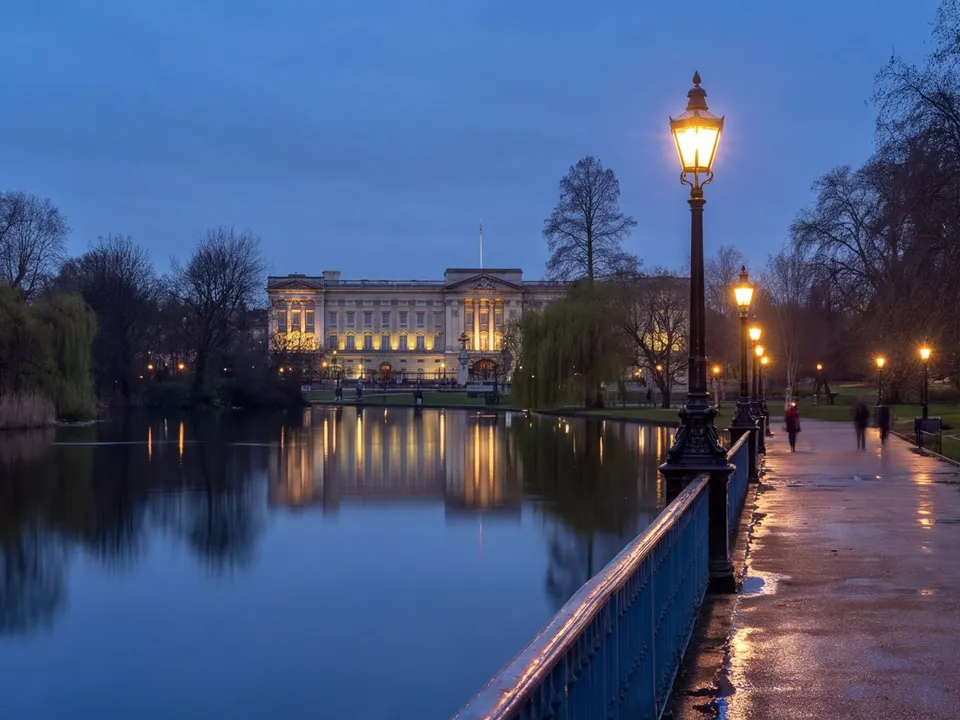
The Blue Bridge is the concrete footbridge across the lake in St James's Park, and it looks west to Buckingham Palace and east to Horse Guards Parade, Big Ben and the London Eye.[1] The present bridge dates from 1957 and is the third to cross the lake.[1] Some pedestrian gates of the park are listed as 05:00 to midnight all year.[7]
History
The bridge you cross now is a concrete span of 1957, and the Royal Parks counts it as the third to cross the lake.[1] The first was designed by John Nash, and Wikipedia dates his Chinese-style bridge to the Grand Jubilee of 1814 and says it survived until 1825.[1][5] An iron suspension bridge followed in 1857, designed by James Meadows Rendel according to an engineering blog.[1][3]
By the 1950s the old bridge had served for a hundred years, and expensive repairs had become necessary.[2] An anonymous donor left £23,000, which could not be used for repairs, so a new bridge replaced the old one; the bequest required work to start before the end of 1956 and the new bridge to be completed by the end of 1957.[2]
A temporary bridge of tubular scaffolding was planned so that pedestrians could cross the lake while the work went on.[2] The Sphere's February 1957 report describes two dams, with the 200,000 gallons between them pumped out.[2] The new bridge's concrete came from lorries of ready-mixed concrete and was placed in one go to avoid joints, by a team of thirty workmen working through the night under arc lights hung from the scaffolding.[2] The Sphere dates that pour to the night of 6 to 7 June 1957.[2]
The Ministry of Works' Structural Engineering Branch designed it, Higgs and Hill built it, and the architect was Eric Bedford.[3] It has three spans, a 21.34-metre centre span flanked by two of 10.67 metres, and it is 4.1 metres wide.[3] One pier is fixed and the other sits on a rocker bearing, a detail the blog ties to the bridge's natural frequency, and the finished bridge was tested with 300 marching guardsmen.[3]
The name comes from the paint rather than the concrete: white aggregate and white cement make the concrete pale, and the blue railings gave the bridge its name.[3] Wikidata lists the bridge as a footbridge with a 1957 inception date.[6]
At night
Some pedestrian and vehicle gates of St James's Park are listed as 05:00 to midnight, every day of the year.[7] Temporary closures for events or maintenance appear in public notices on the park's page, so check before an evening visit.[7]
From the bridge you look west across the lake to Buckingham Palace, and east to Horse Guards Parade, Big Ben and the London Eye.[1] The London Museum calls the outlook from the lake bridge a triple view, taking in Buckingham Palace, St James's Palace and Horse Guards Parade.[4] See Buckingham Palace for the building at the far end of the lake.
Visiting: what to know
At the time of writing, 11 Nov 2026, the Royal Parks lists some of the park's gates as 05:00 to midnight, with closures announced on its website.[7] The lake is also home to a pelican colony, which has lived in the park since 1664, when a Russian ambassador gave pelicans to Charles II.[4][5] The London Museum says visitors can still watch them being fed daily.[4]
Getting there
St James's Park Underground station, on the Circle and District lines, is the closest.[8] Wikipedia names St James's Park, Green Park, Victoria and Westminster as the stations serving the park, and Westminster is on the Circle, District and Jubilee lines.[5][9] The Royal Parks adds that Charing Cross and Victoria are the mainline stations for the park.[7]
Last trains home from 17 London areas
| Station | Lines | Walk, estimated |
|---|---|---|
| St. James's Park | Circle, District | about 450 m, about 6 min |
| Westminster | Circle, District, Jubilee | about 950 m, about 13 min |
| Green Park | Jubilee, Piccadilly, Victoria | about 1.0 km, about 13 min |
Nearby for a drink
Pubs and bars within 600 m of St James's Park Bridge as the crow flies, nearest first, with an estimated walk. Each opens on the London nightlife map.
- Two Chairmen · Pubabout 400 m, about 5 min
- Blue Boar Pub · Pubabout 500 m, about 6 min
- Oxford & Cambridge Club · Loungeabout 500 m, about 7 min
- Westminster Arms · Pubabout 550 m, about 7 min
- Davy's at St James's · Wine barabout 600 m, about 8 min
- Golden Lion · Pubabout 600 m, about 8 min
Clock in here
MYSOVA is a London social passport: clock in at bars, pubs and clubs, earn XP and meet people where you go.



Free · UK App Store and Google Play · 18+
FAQ
Why is it called the Blue Bridge?
Its railings are painted blue, while the concrete itself was made pale with white aggregate and cement.[3]
When was the Blue Bridge built?
What can you see from the Blue Bridge in St James's Park?
Buckingham Palace to the west, and Horse Guards Parade, Big Ben and the London Eye to the east.[1]
Is St James's Park open at night?
Some pedestrian gates are listed as 05:00 to midnight each day.[7]
Which station is nearest to the Blue Bridge?
St James's Park, on the Circle and District lines.[8]
Landmarks in the area
Sources
- 1.The Royal Parks, Monuments in St James's Park. Read .
- 2.The Royal Parks Guild (reproducing The Sphere, 9 Feb and 15 Jun 1957), The construction of the Blue Bridge. Read .
- 3.Happy Pontist (bridge engineering blog), The Blue Bridge, St James's Park (May 2015 post). Read .
- 4.London Museum, The park surrounded by palaces. Read .
- 5.Wikipedia, St James's Park. Read .
- 6.Wikidata, Blue Bridge (Q120000450). Read .
- 7.The Royal Parks, St James's Park FAQs. Read .
- 8.Transport for London, St James's Park Underground Station. Read .
- 9.Transport for London, Westminster Underground Station. Read .