

London landmark
Natural History Museum: history, free entry, getting there
Short answer
History
The case for a separate natural history museum came from Richard Owen, who sketched an "Idea of a Museum of Natural History" in 1859.[1] After four years of campaigning he won approval for a new building in 1863.[1] Captain Francis Fowke won the design competition and received the building contract in 1864, but he died in December 1865.[1][3] Alfred Waterhouse was then hired to revise the scheme, in February 1866 according to Wikipedia.[3]
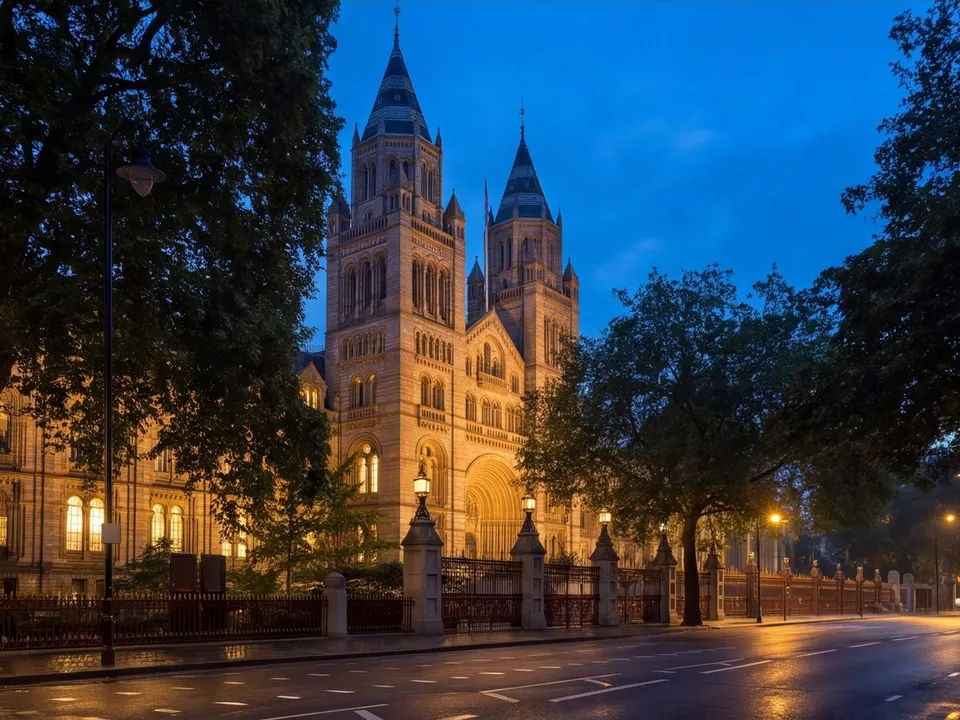
What Waterhouse built is the front you see today. He mixed Gothic Revival with twelfth-century Romanesque, covered the whole building in terracotta, and decorated it with animals and plants.[1] Terracotta was chosen for its resistance to the grime of Victorian London, and the tiles were made by Gibbs and Canning, a firm based in Tamworth.[1][3] The museum opened on 18 April 1881, though moving the collections from the old museum was not finished until 1883.[1][3]
Inside, the ceiling of Hintze Hall carries 162 hand-painted and gilded panels.[1] The hall was formerly the Central Hall, and the Diplodocus cast known as Dippy was taken down in early 2017 after 112 years, replaced by the blue whale skeleton Hope, unveiled on 14 July 2017.[3]
The museum became independent from the British Museum through the British Museum Act 1963, and the name Natural History Museum became official under a 1992 Act.[3] Its infobox gives 7,116,929 visitors for 2025.[3]
At night and at Christmas
This is a daytime museum. The galleries are a daytime visit, so after dark you see the building from outside.[2] At the time of writing, 11 Nov 2026, the museum's visit page lists it closed from 24 to 26 December, and mentions that its shops are decorated for Christmas.[2]
The ice rink that used to fill the grounds in winter has gone. A University of Westminster student report from 24 November 2021 called that year its last, after about 16 years, with the space to be converted into the Urban Nature Project, a five-acre green space.[6]
V&A South Kensington is nearby, and opening times change, so check its official page before you go.[7]
Visiting: what to know
The galleries are free.[2] Some temporary exhibitions charge, and the visit page says that supporters and people with tickets can bypass the queues.[2][3] Opening times change, so check the official page before you go.[2]
On step-free access, the Central Entrance is step-free with a ramp.[4] The East Entrance on Exhibition Road is not step-free, but a lift runs from its lobby to the galleries, and the gate may close at busy times.[4] The West Entrance on Queen's Gate has a lift, and its opening times change, so check the official page before you go.[4] South Kensington station is not step-free, and the museum says to use the subway tunnel for a step-free route to the Central Entrance.[4][5]
Getting there
South Kensington is the closest station, served by the Piccadilly, District and Circle lines.[4] Gloucester Road, on the same three lines, is the other option, and it is not step-free.[4] A pedestrian subway beneath Exhibition Road, which the District Railway opened in 1885, runs from South Kensington station towards the museums.[5]
Last trains home from 17 London areas
| Station | Lines | Walk, estimated |
|---|---|---|
| South Kensington | Circle, District, Piccadilly | about 350 m, about 5 min |
| Gloucester Road | Circle, District, Piccadilly | about 650 m, about 9 min |
On the Christmas lights trails
Stop 4 of 7 on Kensington & Chelsea. See it on the Christmas Trails map.
- Before it: Royal Albert Hall (about 1.0 km, about 13 min on foot)
- Next: The Cadogan Arms (about 1.6 km, about 21 min on foot)
Walking times are estimates from the stops’ coordinates. Every walk: Christmas lights in London.
Nearby for a drink
Pubs and bars within 600 m of Natural History Museum as the crow flies, nearest first, with an estimated walk. Each opens on the London nightlife map.
- Billionaire lounge · Loungeabout 200 m, about 3 min
- Bocca Lounge · Loungeabout 200 m, about 3 min
- Hoop and Toy · Pubabout 250 m, about 3 min
- Zetland Arms · Pubabout 400 m, about 5 min
- K Bar · Cocktail barabout 500 m, about 7 min
- Olives Restaurant and Bar · Barabout 650 m, about 8 min
More nearby: Pubs in Chelsea
Clock in here
MYSOVA is a London social passport: clock in at bars, pubs and clubs, earn XP and meet people where you go.



Free · UK App Store and Google Play · 18+
FAQ
Is the Natural History Museum free?
What time does the Natural History Museum close?
Closing times change, so check the museum's visit page before you go.[2]
Is there still an ice rink at the Natural History Museum?
No. A report from November 2021 described that winter as the rink's last, after about 16 years, because the space was being turned into the Urban Nature Project.[6]
When was the Natural History Museum built?
Which Tube station is nearest the Natural History Museum?
South Kensington, on the Piccadilly, District and Circle lines.[4]
Nearby guides
Area guides
Landmarks in the area
Nearby landmarks
Sources
- 1.Natural History Museum (official site), Alfred Waterhouse: museum building, cathedral to nature. Read .
- 2.Natural History Museum (official site), Plan your visit. Read .
- 3.Wikipedia, Natural History Museum, London. Read .
- 4.Natural History Museum (official site), Getting here. Read .
- 5.Wikipedia, South Kensington tube station. Read .
- 6.The Voice of London (University of Westminster), 24 Nov 2021, Natural History Museum say goodbye to the iconic ice skating rink. Read .
- 7.V&A (official site), Visiting FAQs. Read .