

London landmark
Royal Albert Hall: history, Christmas and getting there
Short answer
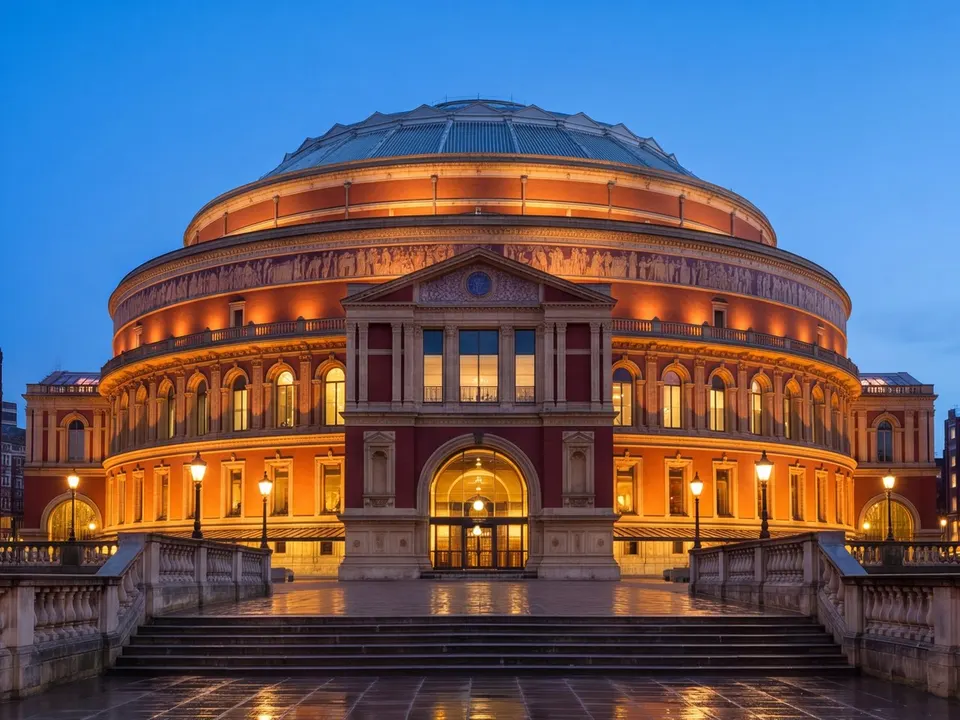
The Royal Albert Hall is the red-brick, oval concert hall on Kensington Gore. It opened in 1871 and now seats 5,272 people[3]. Its promoters aimed to avoid using public funds, selling seats in advance to help pay for it[1], and it is still a working venue that is generally shut in the daytime, so the way in is a concert ticket or a guided tour[5].
History
Henry Cole of the Science and Art Department drove the project and paid for it by selling seats at £100 each[1]. The site was leased to the hall's corporation for 999 years at a shilling a year, and Cole told Gladstone that the building would not depend on public funds[1]. Captain Francis Fowke drew up the original scheme but died in December 1865, and Lieutenant-Colonel Henry Scott of the Royal Engineers developed the design and oversaw the work[1]. Queen Victoria laid the foundation stone on 20 May 1867, and the hall opened on 29 March 1871[1][3]. The Survey of London mentions the Prince of Wales reading an address at the opening ceremony, while Wikipedia says the Queen and the Prince of Wales opened it together[1][3]. The final bill was probably about £214,000[1].
What stands there now is a Grade I listed building, listed on 24 February 1958[2]. Historic England describes an Italian Renaissance design on an elliptical plan, in red brick and buff terracotta, under a glazed domed roof[2]. A mosaic terracotta frieze called The Triumph of Arts and Sciences runs around the outside[3], and seven artists worked on the designs[1]. When the scaffolding came down in May 1870, Cole reported that the roof had deflected by hardly more than a quarter of an inch[1].
Cole's diary records an echo in the balcony in February 1871, and glass-fibre diffusers introduced in 1968 and 1969 appear to have ended the trouble[1]. Those discs are the hanging "mushrooms" under the ceiling[3]. Scott reckoned the finished hall held 7,165 people plus 1,200 singers and instrumentalists, although Wikipedia says it was designed for 8,000, and the seating capacity is 5,272 today[1][3]. The BBC Proms moved here in 1941 after an air raid destroyed the Queen's Hall[3]. The hall also has a political past, because the listing records suffragette activity between 1905 and 1918, including the interruption of a prime minister's speech in 1905[2].
At night and at Christmas
The hall admits visitors for concerts, tours and events and is generally closed during the day[5], and it hosts more than 390 events a year in the main auditorium[5]. The terracotta frieze circles the building, so the outside is worth a look on the way in[3].
For Christmas 2026, Time Out lists Carols at the Royal Albert Hall from 19 to 24 December, with concerts at 11:00, 15:00 and 19:30, fifteen in all[4]. The listing names the Royal Philharmonic Orchestra, the National Youth Choir, the Royal Choral Society and the British Imperial Military Band among the performers[4]. The event web address in that listing carries 2024, so confirm dates and times with the Hall before you book[4].
Visiting: what to know
At the time of writing, 11 Nov 2026, you can get in for a concert, a tour or an event, and the hall is generally closed during the day, so check before you go[5]. Ticket prices are set for each event[5]. A guided tour is listed on various dates and covers the royal areas, the auditorium and the stage[5].
South Kensington is described as the busiest Underground station without step-free access[6]. Knightsbridge became step-free in April 2025, when its Hoopers Court entrance opened[7]. The hall publishes its own accessibility details on its website[5].
Getting there
Four Underground stations are usually given as the nearest: Gloucester Road, High Street Kensington, Knightsbridge and South Kensington[3]. South Kensington is served by the Circle, District and Piccadilly lines[6]. Gloucester Road has the same three lines[8]. High Street Kensington has the Circle and District lines[9], and Knightsbridge has the Piccadilly line[7].
Getting there and home: nearest stations and the way home.
Last trains home from 17 London areas
| Station | Lines | Walk, estimated |
|---|---|---|
| South Kensington | Circle, District, Piccadilly | about 1.0 km, about 14 min |
| Gloucester Road | Circle, District, Piccadilly | about 1.1 km, about 14 min |
| High Street Kensington | Circle, District | about 1.4 km, about 18 min |
On the Christmas lights trails
Stop 3 of 7 on Kensington & Chelsea. See it on the Christmas Trails map.
- Before it: The Scarsdale Tavern (about 2.0 km, about 27 min on foot)
- Next: Natural History Museum (about 1.0 km, about 13 min on foot)
Walking times are estimates from the stops’ coordinates. Every walk: Christmas lights in London.
Clock in here
MYSOVA is a London social passport: clock in at bars, pubs and clubs, earn XP and meet people where you go.



Free · UK App Store and Google Play · 18+
FAQ
Where is the nearest tube station to the Royal Albert Hall?
Is the Royal Albert Hall free to visit?
Not as a walk-in. You get in for a concert, tour or event, the hall is generally closed in the daytime, and ticket prices are set for each event[5].
When was the Royal Albert Hall built?
How many people does the Royal Albert Hall hold?
Why is it called the Royal Albert Hall?
When the foundation stone was laid in 1867 it was renamed the Royal Albert Hall of Arts and Sciences, in memory of Queen Victoria's husband, Prince Albert[3].
Area guides
Landmarks in the area
Sources
- 1.British History Online (London County Council), Royal Albert Hall, Survey of London: Volume 38, South Kensington Museums Area. Read .
- 2.British Listed Buildings, reproducing the Historic England list entry, Royal Albert Hall, Grade I list entry text (Historic England 1217742). Read .
- 3.Wikipedia, Royal Albert Hall. Read .
- 4.Time Out, Carols at the Royal Albert Hall. Read .
- 5.ianVisits, Royal Albert Hall. Read .
- 6.Wikipedia, South Kensington tube station. Read .
- 7.Wikipedia, Knightsbridge tube station. Read .
- 8.Wikipedia, Gloucester Road tube station. Read .
- 9.Wikipedia, High Street Kensington tube station. Read .